

About
Orka provides orchestration and virtualization for virtualized runtime environments on macOS. It is particularly well-suited for continuous integration (CI) build and test processes.Overview
This document outlines the built-in Resiliency, High Availability (HA), and Disaster Recovery (DR) capabilities of Orka Cluster components when hosted on MacStadium. The document also outlines additional solutions, which can be implemented with added complexity and cost to achieve more advanced setups.It is important to note that HA/DR setups can vary significantly in complexity and cost, based on individual needs.
Key components
When considering resiliency, HA, and DR for Orka, we focus on three main software considerations of the system:- Control Plane that orchestrates the workloads
- Images that can be instantiated as VMs
- VM Runtimes that are executing the workloads
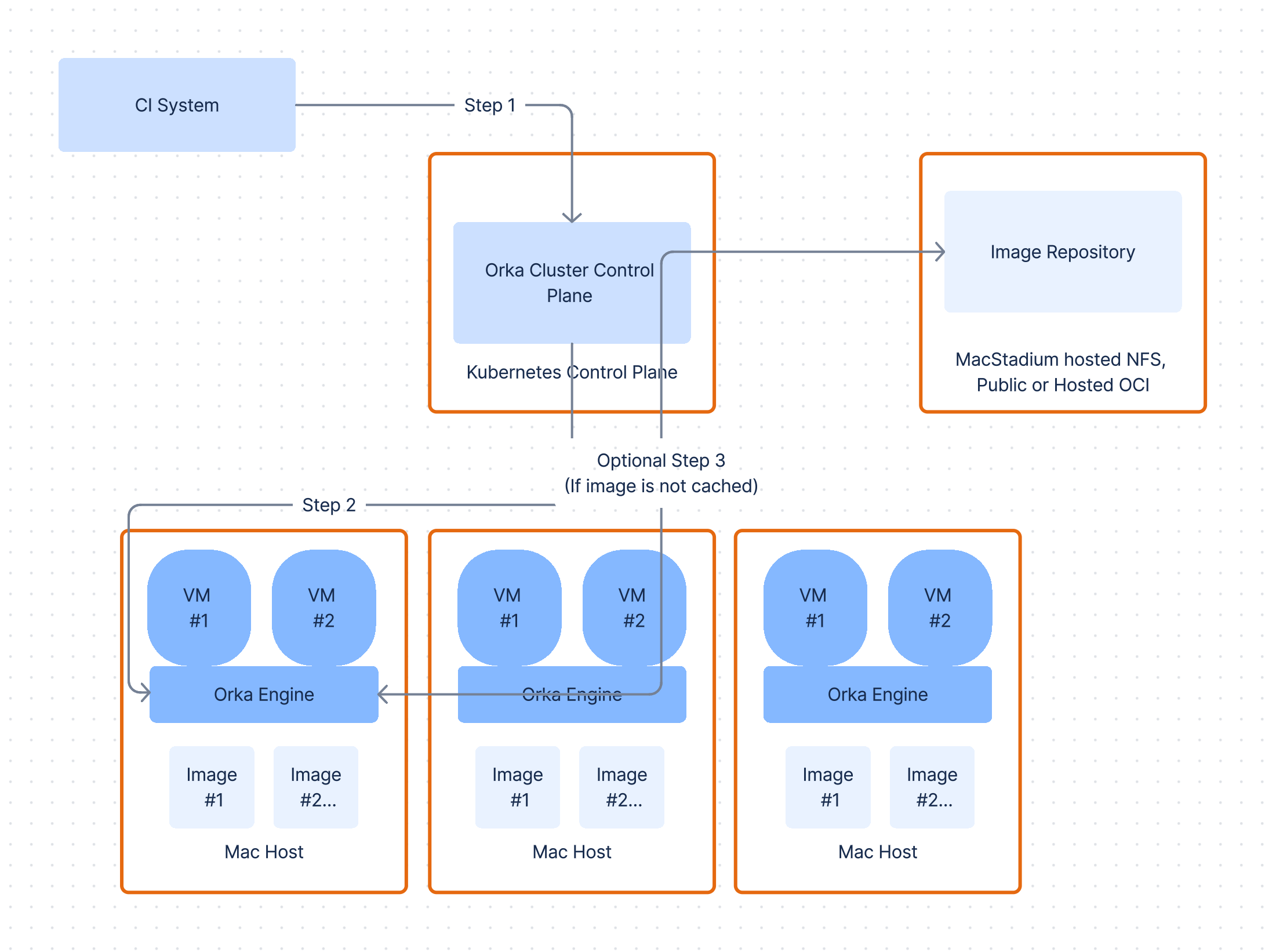 Each component has a different approach and set of requirements to support the availability and recoverability of the Orka environment.
Control plane
The Control Plane is built on k8s, and is responsible for managing and distributing workloads across the system. Resiliency/HA Capabilities- When hosted by MacStadium, Orka Cluster employs an active-active control plane architecture, utilizing three VM hosts located in a single site*. If a node goes down, another node takes over while the failed node restarts.
- Active-active control plane is enabled with Orka Cluster Advanced.
- This setup provides a level of resiliency and High Availability (HA) if one or two control plane nodes fail, so the system can continue orchestrating workloads without interruption.
- MacStadium implements regular backups of control plane configurations, which are stored on the master nodes on the NFS mount.
- In the unlikely event of a complete control plane loss, our Disaster Recovery (DR) plans include the ability to redeploy the control plane based on the most recent backup.
Images
Images are the saved state of a VM on disk that can be used to run VMs. Resiliency/HA Capabilities- When hosted by MacStadium, Orka Cluster stores images in a Pure storage array, known for its high level of resiliency. RAID capabilities provide protection against drive failures.
- If you prefer more control or have existing storage solutions, Orka Cluster supports image storage on any OCI-compliant repository. You can implement High Availability (HA) solutions using the capabilities provided by the repository.
- The Pure storage arrays can take backups at scheduled intervals and store data in adjacent storage for an additional price.
- If you run an OCI-compliant repository, you can implement DR solutions using the capabilities provided by the repository.
Harbor OCI storage
Starting with Orka 3.5, Harbor OCI storage is the default managed storage solution for new Orka deployments. Harbor is a MacStadium-managed, OCI-compliant image registry that provides:- Secure image storage with role-based access control
- Activity auditing and compliance tracking
- Prometheus metrics support
- Automatic resource scaling based on available Orka nodes
VM runtimes
VM Runtimes are the ephemeral macOS instances themselves. These VMs typically execute a job and return some artifacts (such as a build) when complete. Resiliency/HA Capabilities- In a failure, these VMs are quickly and easily restarted by the calling applications. The VMs run on a single macOS host/node and do not provide any built-in HA capabilities.
- VMs are intended to be ephemeral and do not implement DR capabilities.
Planning for node disk headroom
Orka does not currently check available host disk space before placing a VM. If a node runs out of disk under write load, guest filesystem writes can fail outright, and in some cases this has caused unrecoverable APFS corruption on the affected VM. Sizing your nodes with enough headroom is on you today.Sizing math
Before deploying, add up:- The maximum provisioned size of every VM you expect to run concurrently on a node, not each VM’s current usage.
- The size of your image cache, every distinct image cached on that node.
Reclaiming space with image cache management
On Orka 3.6.3 and later,orka3 imagecache remove removes a specific cached image from one node, a set of tagged nodes, or every node in a namespace, freeing the space it was holding. See Image Caching for the full FAQ and command reference. This is the most direct lever you have today to reclaim host disk headroom.
If you’re on an earlier version, upgrading to 3.6.3 or later is the recommended path to get this capability.
Host-level disk monitoring and alerting are on our roadmap but not yet available. Until then, the sizing math above and image cache management are the levers within your control.
Redundant data centers
To achieve a resilient solution across multiple data centers, MacStadium works with customers to architect a solution to route traffic between multiple geographic sites. These solutions are designed for customers who need near-continuous uptime and wish to mitigate risks associated with localized disruptions. They are not out of the box and require additional design considerations with our team.Cluster deployment across data centers
In a redundant data center configuration, you can balance workloads between data centers using a load balancer or traffic router that sits above both clusters. You can distribute and route workloads to the most suitable site based on resource availability or performance considerations. This solution supports use cases like high availability, blue/green deployments, and rolling upgrades. It also enables testing of new deployments without risking production environments and allows for a controlled fallback if any issues are encountered. In the event of a failure at one data center, the load balancer is reconfigured and redirects all traffic to the operational cluster. The details of this failover mechanism are designed to meet the SLAs of the customer.Additional responsibilities
Effective High Availability / Disaster Recovery is a shared responsibility between MacStadium and our customers.Understanding these responsibilities is crucial for maintaining a strong HA/DR posture.
MacStadium responsibilities
- MacStadium is committed to ensuring that all hardware provided to the customer is operational and performing as expected.
- In the event of a failure, MacStadium is prepared to rebuild an Orka Cluster environment specific to that customer. This ensures that customers can resume operations as quickly as possible.
- MacStadium continuously monitors and maintains the underlying infrastructure to prevent potential issues before they impact customer operations.
Customer responsibilities
- If you store images in OCI-compliant repositories, implementing and managing DR plans for these images is your responsibility.
- Maintain up-to-date documentation of your Orka Cluster configurations to facilitate faster recovery.